
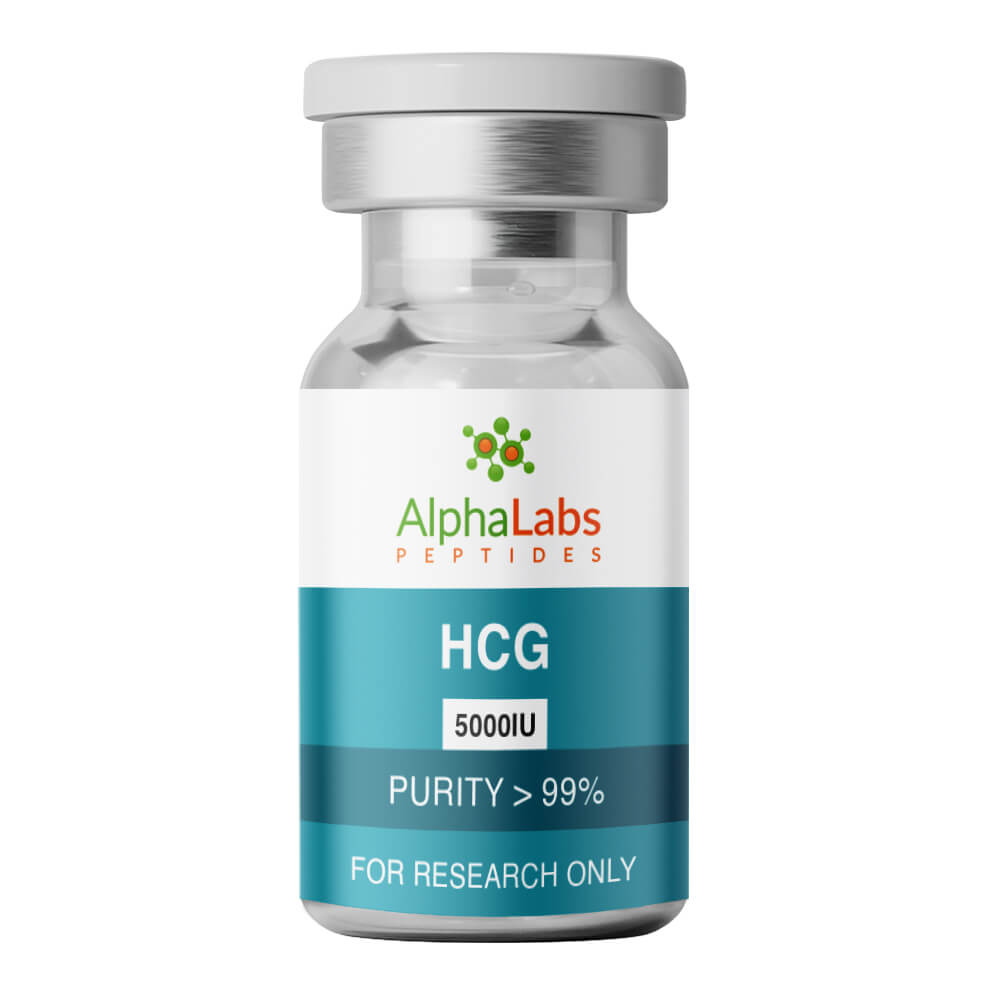
HCG (5000IU)
Table of Contents
Quickstart Highlights
HCG 5000iu dosage protocol provides research-based guidance for hormonal support, fertility induction, and testicular function maintenance via subcutaneous or intramuscular injections.
- Typical maintenance dose: 250–500 IU (10–20 u) 2–3×/week
- Fertility stimulation: 1,500–2,000 IU (30–40 u) 3×/week
- Ovulation trigger (female): one-time 5,000–10,000 IU IM/Sub-Q
- Reconstitute with 2–3 mL bacteriostatic water for accurate syringe units
- Store lyophilized in the freezer; reconstituted in the refrigerator
Dosing & Reconstitution Guide
Educational guide for reconstitution and dosing protocol
Standard / Gradual Approach (2 mL = 2,500 IU/mL)
| Phase | Per-Injection Dose (IU & μg) | Units (mL) |
|---|---|---|
| Weeks 1–4 | 250 IU (≈9.5 μg) | 10 u (0.10 mL) |
| Weeks 5–12 | 500 IU (≈19 μg) | 20 u (0.20 mL) |
deal for hormone-maintenance research or adjunct use with exogenous testosterone. Inject 2–3 times weekly (e.g., Mon/Wed/Fri). One 5,000 IU vial reconstituted with 2 mL supplies ten 500 IU injections (~3 weeks).
- Draw 2.0 mL bacteriostatic water into a sterile syringe.
- Inject slowly along the vial wall to avoid foaming.
- Gently swirl until clear—do not shake.
- Label the vial with concentration and date; refrigerate (2–8 °C).
Advanced / Aggressive Approach (1 mL = 5,000 IU/mL)
| Phase | Per-Injection Dose (IU & μg) | Units (mL) |
|---|---|---|
| Weeks 1–8 | 1,500 IU (≈57 μg) | 30 u (0.30 mL) |
| Weeks 9–16 (Optional) | 2,000 IU (≈76 μg) | 40 u (0.40 mL) |
Commonly used for fertility-induction or intensive recovery studies. Inject 3 times weekly. Monitor estradiol and testosterone; adjust dose if adverse estrogenic effects occur.
- Reconstitute with 1.0 mL bacteriostatic water for a concentrated solution.
- Follow the same gentle mixing technique as above.
- If any single injection exceeds 0.6 mL (≥60 u), split into two sites.
Protocol Overview
Summary of common HCG research applications and scheduling.
- Goal : Maintain intratesticular testosterone, stimulate spermatogenesis, or trigger ovulation (female models)
- Schedule : 2–3× weekly (maintenance) or intensive thrice-weekly courses (fertility)
- Dose Range : 250–2,000 IU per injection depending on protocol
- Reconstitution : 2 mL for standard, 1 mL for high-dose studies; do not exceed 3 mL
- Storage : Lyophilized at −20 °C; reconstituted at 2–8 °C
Dosing Protocol
Choose the approach that best fits your research objective.
- Maintenance : 250–500 IU per injection, 2–3× weekly
- Fertility Stimulation : 1,500–2,000 IU per injection, 3× weekly for up to 16 weeks
- Ovulation Trigger (Female) : Single 5,000–10,000 IU injection 34–36 h pre-retrieval
- Monitoring : Track hormone panels and adjust as required
Storage Instructions
Maintain peptide integrity with correct storage.
- Lyophilized : Freeze until mixing (−20°C)
- Reconstituted : Refrigerate at 2–8°C
- Avoid direct light and repeated freeze-thaw cycles
Suppilies Needed
Basic lab consumables for a 12–16 week study.
- Peptide Vials :
-
- 4 wks ≈ 1 vial
- 8 wks ≈ 2 vials
- 12 wks ≈ 3 vials (Higher-dose fertility protocols may need additional vials)
- Insulin Syringes (1 cc, 30–31 G) :
-
- One per injection (e.g., 36 for 12-week maintenance)
- Bacteriostatic Water : 1 × 30 mL
- Alcohol Swabs: 1 box
Important Notes
Practical guidance to enhance accuracy and safety during experimentation.
- Rotate injection sites and use sterile technique to reduce irritation.
- Verify syringe unit conversions after each reconstitution.
- Monitor hormone panels in long-term studies to track physiological impact.
- Immediately discard any solution that becomes cloudy or contains particles.
How This Works
HCG mimics luteinizing hormone (LH), binding LH receptors on Leydig and theca cells.
- Testicular Action (Male) : Stimulates testosterone synthesis, preserving spermatogenesis
- Ovarian Action (Female) : Triggers final oocyte maturation when administered mid-cycle
- Activates cAMP signaling pathways leading to steroidogenesis in gonadal tissue
Potential Benefits & Side Effects
Outcomes vary by protocol and test model; monitor appropriately.
- Supports endogenous steroid production and fertility parameters
- Helps preserve testicular size/function during testosterone administration
- Possible estrogenic effects (e.g., gynecomastia) at higher doses
- Injection-site reactions or mild mood/energy fluctuations may occur
Lifestyle Factors
While HCG acts hormonally, optimal outcomes rely on holistic research parameters.
- Standardize diet and activity in experimental cohorts to reduce confounders
- Employ consistent sampling times for hormone assays
- Ensure adequate recovery and stress-management protocols in animal or human subjects
Injection Technique
Simple guidelines for safe daily injections.
- Clean vial rubber stopper & injection site with alcohol swabs
- Insert needle at a 45–90° angle into subcutaneous tissue
- Inject slowly & rotate sites (abdomen, thigh, etc.)
Recommended Source
We recommend Go Alpha Labs for high-purity BPC-157 + TB-500 blend.
Why Go Alpha Labs?
- Verifies ≥99% purity through independent lab testing
- Trusted by researchers seeking reliable results
- Follows rigorous manufacturing standards for consistent quality
Important Note:
This guide is for educational purposes only. Always consult a qualified healthcare provider before starting or modifying any therapy.
References:
| Source | Link |
|---|---|
| PubMed – Low-dose HCG fertility study | View Source |
| PubMed – Intratesticular T maintenance trial | View Source |
| FDA Label – Ovidrel prescribing information | View Source |
| UW Health – HCG trigger shot instructions | View Source |
| Kaiser Permanente – IVF & HCG FAQ document | View Source |
| Mayo Clinic – Ovarian hyperstimulation overview | View Source |