
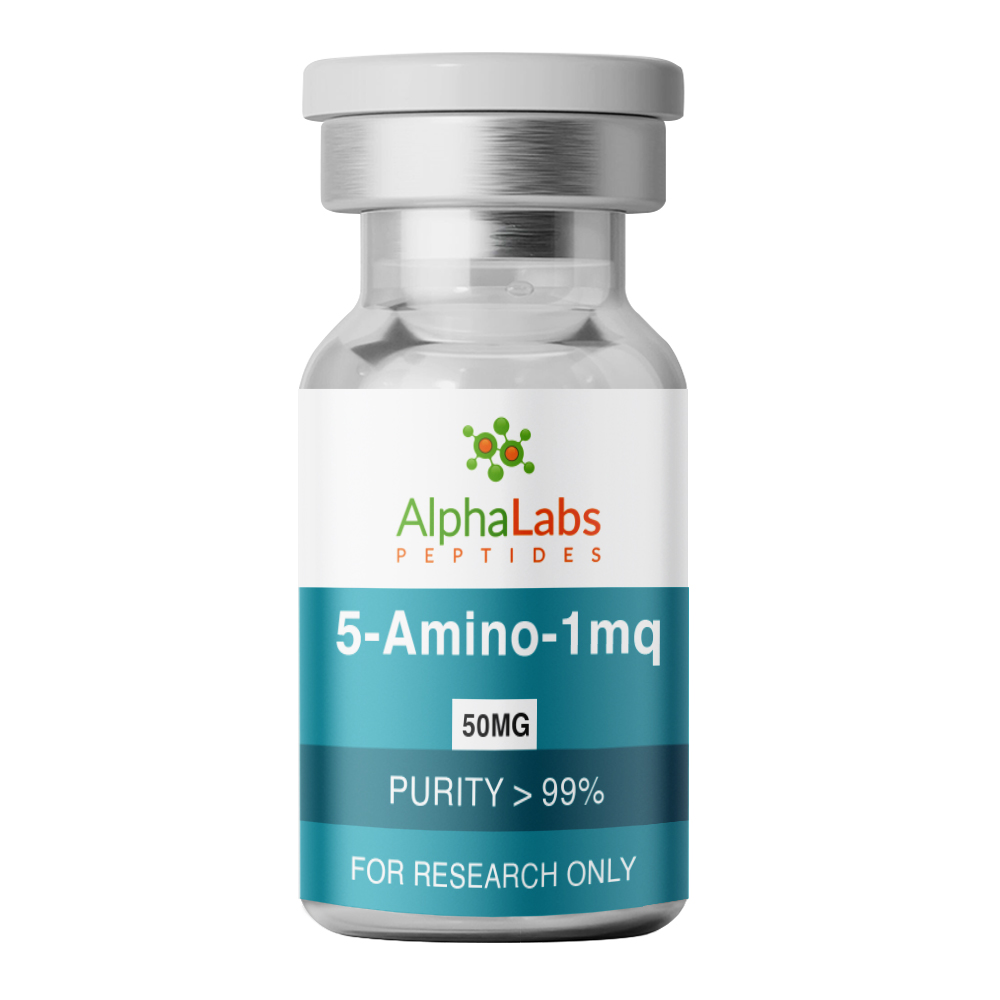
5-Amino-1MQ (50mg)
Table of Contents
Quickstart Highlights
5-Amino-1MQ dosage protocols center on this selective, cell-permeable NNMT (Nicotinamide N-methyltransferase) inhibitor studied for its potential to support fat metabolism, preserve lean muscle mass, and elevate intracellular NAD+ levels[1][2]. By blocking NNMT, 5-Amino-1MQ may help restore cellular energy balance and activate SIRT1 pathways associated with metabolic efficiency[3]. This educational protocol presents a subcutaneous injection approach to maximize bioavailability from the 50 mg vial format.
- Reconstitute: Add 4.0 mL bacteriostatic water → 12.5 mg/mL concentration.
- Typical daily range:2.5–5 mg once or twice daily (subcutaneous).
- Easy measuring: At 12.5 mg/mL, 1 unit = 0.01 mL = 0.125 mg (125 mcg) on a U-100 insulin syringe.
- Storage: Lyophilized: freeze at −20 °C (−4 °F); after reconstitution, refrigerate at 2–8 °C (35.6–46.4 °F) and use within 2–4 weeks.
Dosing & Reconstitution Guide
Educational guide for reconstitution and dosing protocol
Subcutaneous Protocol (4 mL = 12.5 mg/mL)
| Phase | Daily Dose (mg) | Units (per injection) (mL) |
|---|---|---|
| Days 1–2 (Tolerance) | 2.5 mg once daily | 20 units (0.20 mL) |
| Days 3+ (Standard) | 5 mg once daily | 40 units (0.40 mL) |
| Alternative BID | 2.5 mg twice daily | 20 units (0.20 mL) × 2 |
Frequency: Inject once or twice daily subcutaneously. Due to the compound’s plasma half-life of approximately 3.8–6.9 hours[4], twice-daily (BID) dosing may provide more sustained NNMT inhibition. A single 50 mg vial provides 10–20 days of research material at these doses.
Reconstitution Steps
- Remove the vial from freezer storage (−20 °C / −4 °F) and allow to equilibrate at room temperature for 15–20 minutes.
- Draw 4.0 mL bacteriostatic water with a sterile syringe.
- Inject slowly down the vial wall; avoid foaming.
- Gently swirl/roll until dissolved—solution should be clear (do not shake).
- Label and refrigerate at 2–8 °C (35.6–46.4 °F), protected from light; use within 2–4 weeks.
Protocol Overview
Concise summary of the subcutaneous regimen.
- Goal: Support metabolic efficiency through NNMT inhibition, potentially enhancing fat oxidation and NAD+ levels[1][2].
- Schedule : Daily subcutaneous injections; each 50 mg vial provides 10–20 days of research material.
- Dose Range : 2.5–5 mg once or twice daily.
- Reconstitution : 4.0 mL per 50 mg vial (12.5 mg/mL) for accurate measurements.
- Storage : Lyophilized frozen at −20 °C (−4 °F); reconstituted refrigerated at 2–8 °C (35.6–46.4 °F).
Dosing Protocol
Suggested approach for the 50 mg vial format.
- Start : 2.5 mg once daily to assess tolerance.
- Target: 5 mg once daily or 2.5 mg twice daily (BID).
- Frequency:Once or twice per day (subcutaneous).
- Vial Duration: Single 50 mg vial lasts 10–20 days at research doses.
- Timing: Morning administration preferred; BID dosing may be split AM/PM.
Storage Instructions
Proper storage preserves compound stability.
- Lyophilized: Store at −20 °C (−4 °F) in dry, dark conditions; stable up to 24 months.
- Reconstituted: Refrigerate at 2–8 °C (35.6–46.4 °F); use within 2–4 weeks.
- Allow vials to reach room temperature before reconstitution to prevent condensation and pressure issues.
- Do not refreeze reconstituted solution.
Suppilies Needed
Plan based on research duration using the 50 mg vial format at 5 mg/day.
- 5-Amino-1MQ Vials (50 mg each):
-
- 1 week (5 mg/day) ≈ 1 vial
- 2 weeks (5 mg/day) ≈ 1 vial
- 4 weeks (5 mg/day) ≈ 2 vials
- Insulin Syringes (U-100): </b
-
- Per week (once daily): 7 syringes (1/day)
- Per week (BID): 14 syringes
- 4 weeks (once daily): 28 syringes
- Bacteriostatic Water (10 mL bottles): ~Use 4.0 mL per vial for reconstitution.
-
- 1 week (1 vial): : 4 mL → 1 × 10 mL bottle
- 2 weeks (1 vial): 4 mL → 1 × 10 mL bottle
- 4 weeks (2 vials): 8 mL → 1 × 10 mL bottle
- Alcohol Swabs: One for the vial stopper + one for the injection site each administration.
-
- Per week (once daily): 14 swabs
- 4 weeks (once daily): 56 swabs → recommend 1 × 100-count box
Important Notes
Practical considerations for consistency and safety.
- Use new sterile insulin syringes for each administration; dispose in a sharps container.
- Rotate injection sites (abdomen, thighs, upper arms) to reduce local irritation.
- Inject slowly; a mild stinging sensation may occur due to the quinolinium structure.
- Document daily dose and site rotation to maintain consistency.
- The 50 mg vial format is ideal for extended research cycles; a single vial can last 10–20 days.
How This Works
5-Amino-1MQ (5-amino-1-methylquinolinium) is a synthetic small molecule that selectively inhibits Nicotinamide N-methyltransferase (NNMT)[1]. NNMT is an enzyme that methylates nicotinamide (vitamin B3) using S-adenosylmethionine (SAM) as a methyl donor. In states of obesity and metabolic dysfunction, NNMT is often overexpressed in adipose tissue, depleting nicotinamide and reducing NAD+ availability[2].
By inhibiting NNMT, 5-Amino-1MQ may spare nicotinamide for NAD+ synthesis, thereby activating SIRT1 (Sirtuin 1) pathways associated with mitochondrial biogenesis and fat oxidation[3]. Preclinical studies indicate that NNMT knockdown or inhibition can protect against diet-induced weight gain and improve metabolic parameters without reducing food intake[5][6].
Potential Benefits & Side Effects
Observations from preclinical and early research literature.
- May support reductions in fat mass while preserving lean muscle in animal models[5][6].
- Associated with elevated NAD+ levels and SIRT1 activation in preclinical studies[2][3].
- Enhanced grip strength observed in aged mice when combined with exercise[7].
- Generally well tolerated; occasional reports of mild headache, transient jitteriness, or injection-site reactions.
- Long-term human safety data not established; this compound remains investigational.
Lifestyle Factors
Complementary strategies for best outcomes.
- Pair with a balanced, protein-forward diet tailored to energy needs.
- Combine resistance training and aerobic activity—preclinical data suggest synergy with exercise[7].
- Prioritize sleep and stress management to support metabolic adaptation.
- Consider complementary NAD+ precursors (NMN/NR) per emerging stack protocols[8].
Injection Technique
General subcutaneous guidance from clinical best-practice resources[9].
- Clean the vial stopper and skin with alcohol; allow to dry.
- Pinch a skinfold; insert the needle at 45–90° into subcutaneous tissue[10][11].
- Do not aspirate for subcutaneous injections; inject slowly and steadily[10].
- Rotate sites systematically (abdomen, thighs, upper arms) to avoid lipohypertrophy[12].
- Slow injection may minimize any stinging sensation associated with the compound.
Recommended Source
We recommend Go Alpha Labsfor high‑purity 5-Amino-1MQ (50mg)
.
Why Go Alpha Labs?
- Verifies ≥99% purity through independent lab testing
- Trusted by researchers seeking reliable results
- Follows rigorous manufacturing standards for consistent quality
Important Note:
This content is intended for therapeutic educational purposes only and does not constitute medical advice, diagnosis, or treatment.
References:
| Source | Link |
|---|---|
| Nature Medicine (2014) – Nicotinamide N-methyltransferase knockdown protects against diet-induced obesity | View Source |
| PMC (2024) – Nicotinamide N-methyltransferase inhibition mitigates obesity-related metabolic dysfunctions | View Source |
| Frontiers in Pharmacology (2024) – NNMT: a novel therapeutic target for metabolic syndrome | View Source |
| PubMed (2021) – LC-MS/MS assay for 5-amino-1-methylquinolinium: pharmacokinetic and oral bioavailability study | View Source |
| ResearchGate (2021) – Combined NNMT inhibition and reduced-calorie diet normalizes body composition in obese mice | View Source |
| PMC (2022) – Reduced calorie diet combined with NNMT inhibition establishes a distinct microbiome in DIO mice | View Source |
| Scientific Reports / NMN.com – Role of NNMT inhibition in muscle strength: enhanced grip strength with exercise | View Source |
| Swolverine – 5-Amino-1MQ mechanism, benefits, stacking and cycling guide | View Source |
| PMC – Subcutaneous drug injection review: pharmacologic considerations | View Source |
| CDC – Vaccine administration: subcutaneous route (angle/site; no aspiration) | View Source |
| CDC (Subcutaneous Injection PDF) – Technique diagram and site guidance for subcutaneous injections | View Source |
| NCBI Bookshelf – Best practices for injection (asepsis, preparation, and administration) | View Source |
| Journal of Medicinal Chemistry (ACS) – Bisubstrate inhibitors of NNMT with enhanced activity | View Source |
| PMC – NNMT: a bad actor in fat makes good in liver | View Source |